We believe value is the point

Profit is an opinion, cash is a fact, and value is today's price for tomorrow's cash.

Every business should be able to prove the value it creates — not just report the profit it made. So we built the model that does: a balanced, driver-based plan where value is the output and every number traces to its source.

Deterministic engineTenant-isolatedAudit trailDPA/EULA available
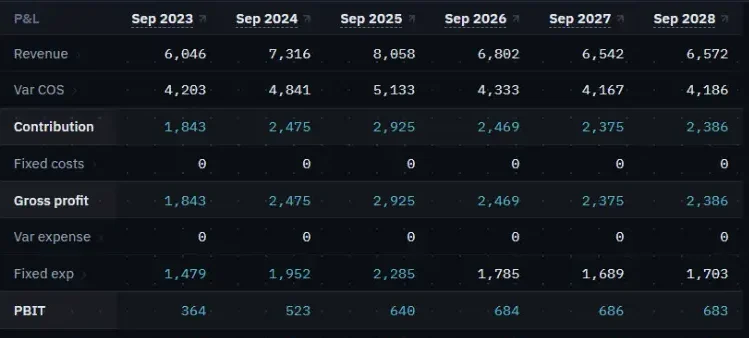
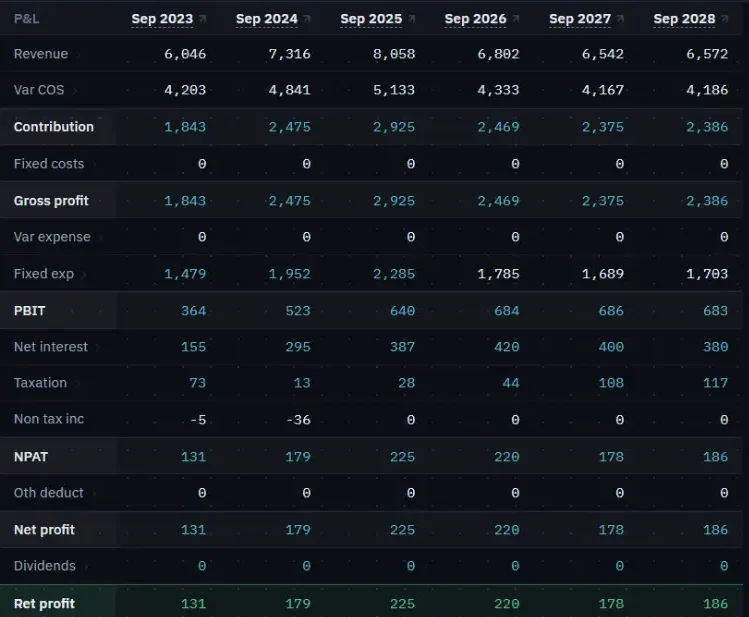
ValueOptix multi-period profit & loss — six years on one screen
Illustrative — demo model.
36forecast periods on one screen
450+documented financial equations
3 → 1valuation methods, one enterprise value
10,000simulations, in milliseconds
0black boxes

Why we exist

  • We believe a business should be judged by the value it creates — not the budget it hits.
  • We believe a model should prove itself — every number traceable, the balance sheet always true.
  • We believe the method shouldn't cost six months of consultants before it exists.

That's why we built ValueOptix.

Spreadsheets break. EPM projects crawl.

The planning category has a default way of doing things — and a well-documented cost. Our belief is the response to it.

The problem

The implementation marathon

Dedicated planning platforms routinely take three to six months to implement — with consultants doing the modelling. And when conditions change, 45% of FP&A teams need a week or more to produce a decision-ready forecast.

Source: Vena Solutions, 2026 FP&A Impact Report; ERPImplementation.eu, 2026

→ ValueOptix: Bring your history. The model exists the same day — you spend your time planning, not configuring.

The problem

Value lives in a separate spreadsheet

Shareholder value analysis, EVA and enterprise valuation live in investor analytics tools or consulting engagements — not in the operating plan the finance team drives. So the plan says profit, and the value question gets answered somewhere else, later.

Analyst note: Stern Value Management; ISS STOXX EVA, 2026 — the value lens exists in the market, but not inside a corporate planning model.

→ ValueOptix: RONA/SVA/FCF trees, capital charges and a three-method valuation — native to the plan, per period, clickable to their equations.

The problem

Statements that don't tie

Only about one organisation in five fully integrates its P&L, balance sheet and cash flow. The rest store three half-conversations in different files.

Source: OneStream, The Future of FP&A 2026

→ ValueOptix: Balance by construction. The overdraft is the derived plug and a live reconcile panel proves the tie-out on every edit.

The problem

Scenario chaos

Only 19% of finance teams can run a scenario in real time or within a day — and 14% can't run scenarios at all. Best case, base case, worst case: three copies of the same workbook, each quietly drifting as formulas break.

Source: FP&A Trends Survey 2026

→ ValueOptix: Change the driver; everything recomputes. Scenarios are answers, not versions.

How we prove it.

The belief is only credible if the method delivers. Five convictions — each one testable inside the product.

  • 01

    A complete method, not a blank canvas

    The engine, screens, equations and reconciliations are pre-wired. Import a company's history and you hold a working, balanced model — drivers, three statements, value trees, valuation, risk.

    From your history to your plan on day one.

  • 02

    The balance sheet is the model — and it balances

    Closing balance sheets chain from the prior period; the bank overdraft is the derived plug, so the opening balance sheet cannot sit unbalanced. A live reconcile panel proves net assets equal capital and retained profit reconciles.

    A model that can't lie about balance.

  • 03

    Value is a native output

    RONA, SVA and FCF driver trees, the cost-of-capital charge and a three-method valuation reconciled to one enterprise value are always on, per period — every figure clickable to its equation.

    Value creation, priced.

  • 04

    Deterministic and traceable — no black boxes

    Calculation is by documented equation, not a learned model. Uncertainty is handled by Monte Carlo with published parameters, not a language model guessing the forecast.

    Every number points back to an input.

  • 05

    Two-way, at planning speed

    Enter actuals line-by-line or import them, then switch to drivers without losing fidelity — the reconciliation is enforced at the switch. The full P&L → balance sheet → cash chain recomputes live across up to 36 periods.

    36 periods, one page, sub-second.

Plan. Understand. Decide.

Plan

Plan like an analyst, not a spreadsheet janitor.

A driver deck that names every lever — price, volume, variable cost, working-capital days, tax, interest, capital structure — each with a value and a plain-English explanation. Move one; the statements follow instantly, across every period.

ValueOptix profit & loss statement — Revenue 6,046 to Ret profit 131 across Sep 2023 to Sep 2028
Illustrative — demo model.
Explore the driver deck →

Understand

See what actually creates value.

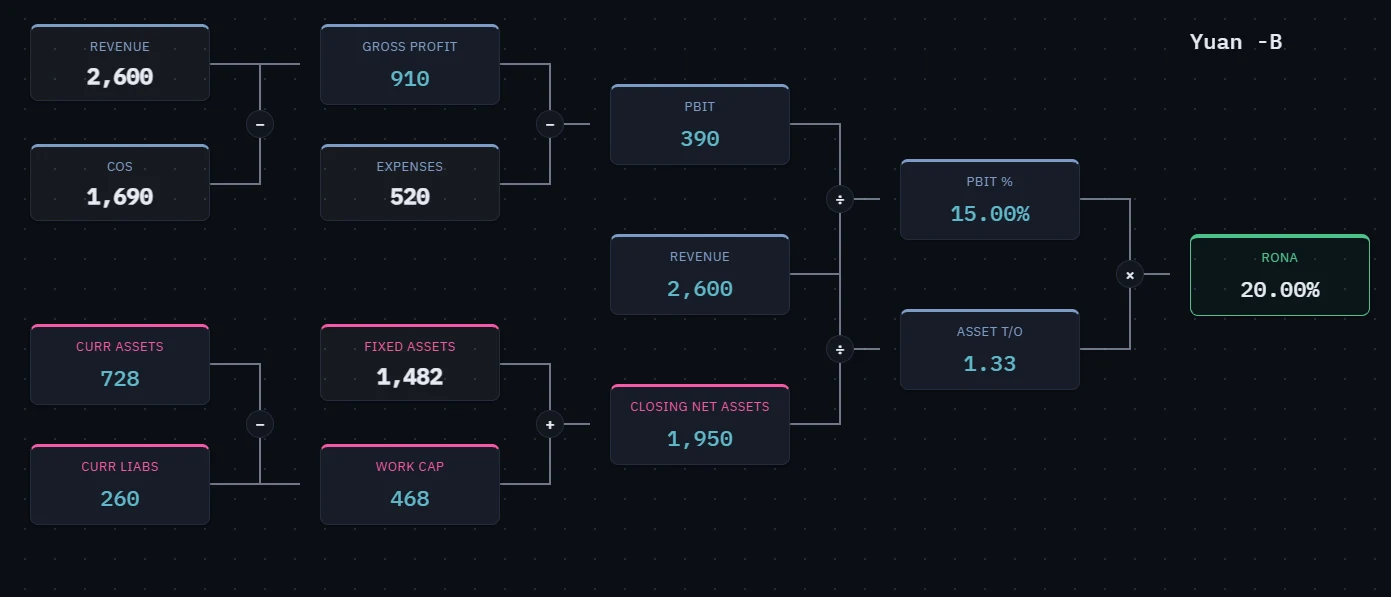
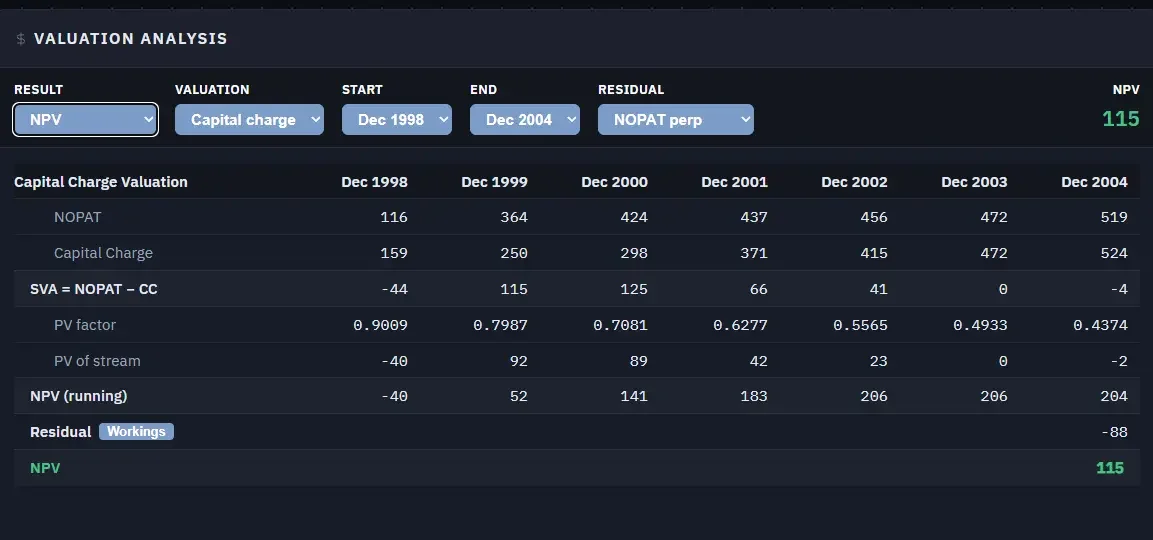
RONA, SVA and FCF trees expose the causal chain from operating drivers to shareholder value, and the valuation bridge carries the same forecast through to enterprise value and share price. Click any figure and you are looking at the equation that produced it — nothing is a mystery number.

ValueOptix RONA value tree — Revenue 2,600 and COS 1,690 divide with net assets to produce RONA 20.00%
ValueOptix valuation analysis — capital-charge valuation from Dec 1998 to Dec 2004 reconciling to a single NPV of 115
Illustrative — demo model.
Open a value tree →

Decide

Test the decision before you make it.

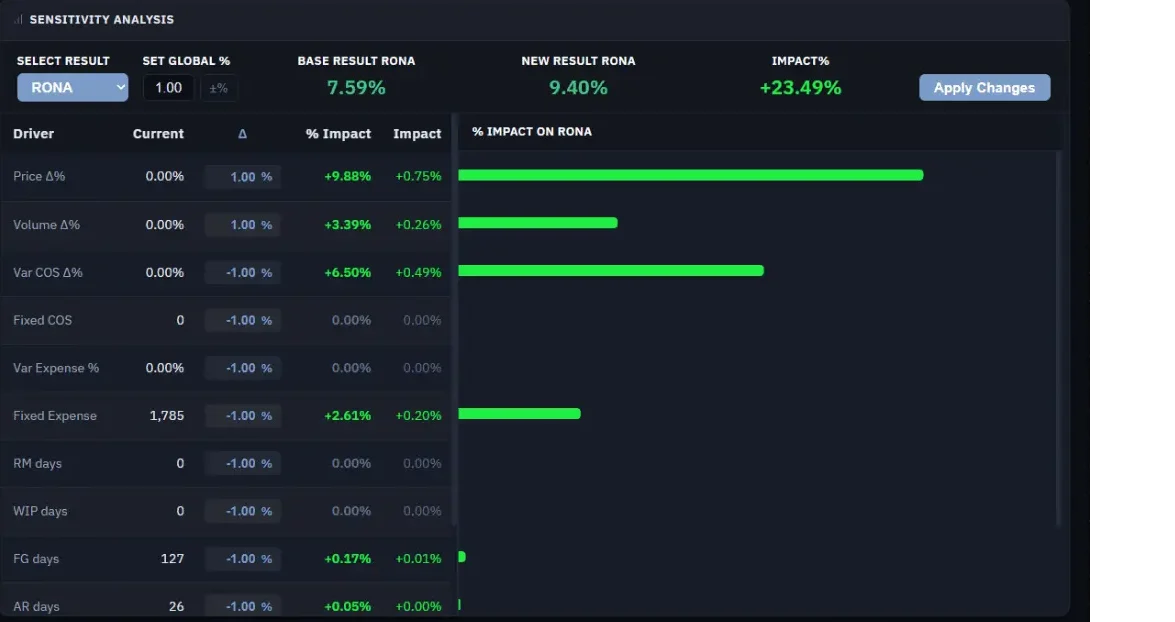
Sensitivity across twelve drivers in one pass. Goal seek solves the driver that hits your target. Monte Carlo runs ten thousand futures. A risk register weights each exposure through the value tree — not by gut feel.

ValueOptix sensitivity analysis — base RONA 7.59%, new RONA 9.40%, +23.49% impact across drivers
Illustrative — demo model.
Run a scenario →

Two ways in. One source of truth.

Bring your actuals, or enter them directly — then switch to drivers without losing a thing.

Path 1 — Connect your history (one afternoon)

Point ValueOptix at your historical statements. The opening balance sheet auto-balances and your figures are verified against an independent 315-equation legacy engine, and the reconcile panel confirms the tie before you type a single plan number.

Path 2 — Enter (or mix)

Prefer keyboard entry? Input Mode takes actual line values directly. When you switch back to drivers, the transition is validated — the model must reproduce your figures before it lets go of them.

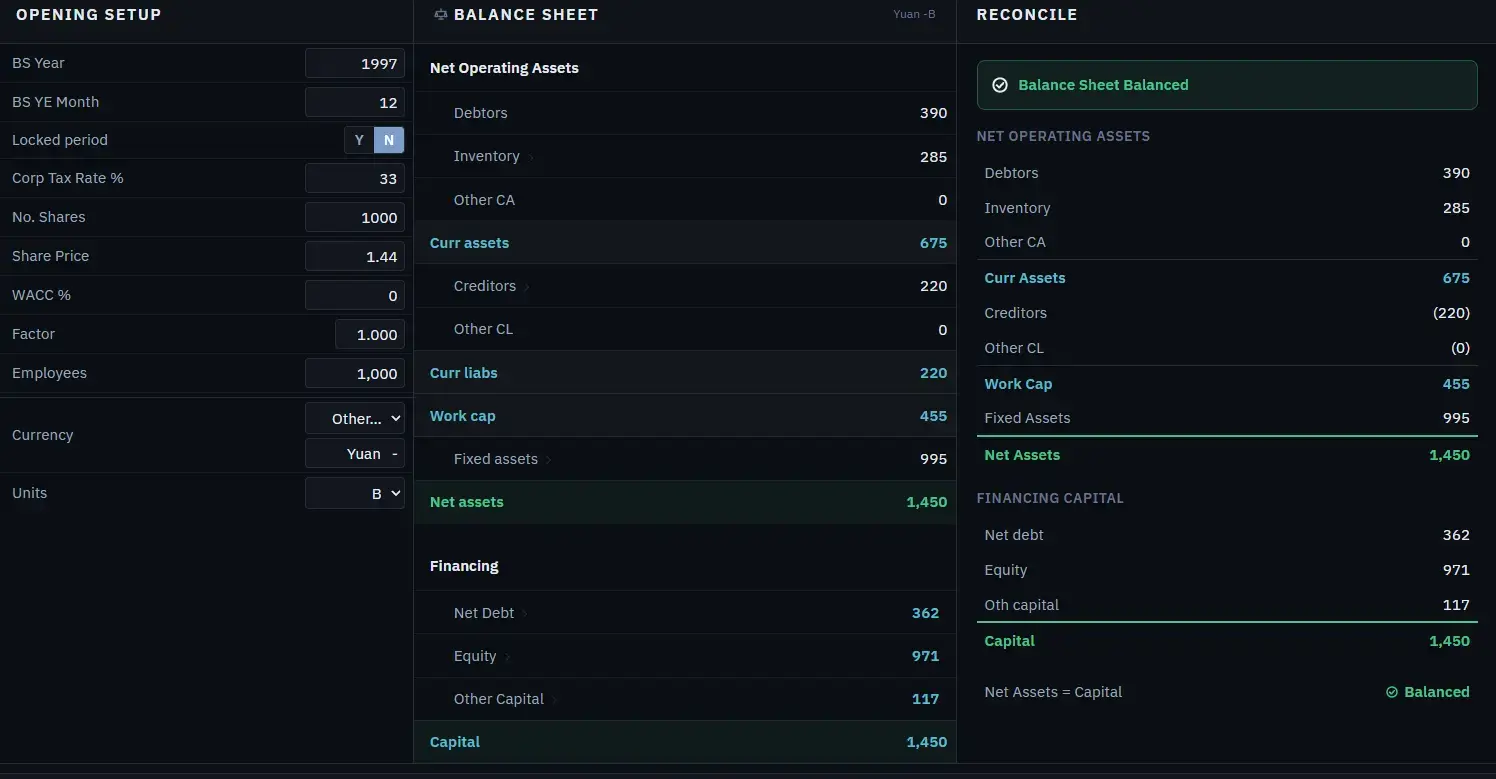
ValueOptix single-period view — Balance Sheet proving Net Assets 1,450 equal Capital 1,450, Reconcile panel reading Balanced
The single-period view with its live reconcile panel — illustrative, demo model.
Balance Sheet BalancedRetained Profit Reconciles

The same status badges analysts see in the product, shown live.

The category default vs ValueOptix

The category defaultValueOptix
The value lensProfit-forward; valuation and risk are add-ons if they exist at allSVA/EVA trees, three-method valuation, Monte Carlo and risk native to the model
Getting startedA project: months of implementation, the model built by consultantsYour history, reconciled and live on day one
Three statementsP&L-led; balance sheet and cash flow the weak leg — only ~19% fully integrate all threeBalanced by construction, proven live by the reconcile panel
Scenario workVersion sprawl — every trial is a new file or a ticket to a specialistChange the driver; read the recomputed answer in place
TrustConfidence by reputationEvery number points back to a named input and equation

Category statistics carry their named sources (OneStream 2026; Vena 2026; ERPImplementation.eu 2026).

Built for people who have to be right.

CFOs & FP&A leadsStrategy & corporate developmentCompensation & reward committeesAdvisors & dealmakersOwner-operatorsFinance teams who must show their workFind your fit →
“You can finally show the board how a driver decision becomes a value outcome.”
What the model lets you do — a product value claim, not a customer quote

A model someone can audit.

Deterministic equations — no black boxes. Tenant isolation with role-based access (and a dedicated-database option), a complete audit trail, SSO and licence-key sign-in, rate limiting and a security pack built for procurement: security brief, DPA and EULA available on request.

Deterministic engineTenant-isolatedRBACAudit trailSSO availableDedicated-DB option
Request the security brief →

Questions, answered.

Do we need a consultant to set it up?

No. The financial method comes pre-wired — you import your history and start planning. There is no build phase and no model-config language to learn.

How does our history get in?

Import your history via a template CSV. The import is idempotent — re-run it safely — and the opening balance sheet must pass the reconcile panel before you plan on it.

Can the balance sheet go out of balance?

By construction, no: the bank overdraft is the derived balancing item, and a live reconcile panel confirms net assets equal capital on every edit. Exiting Input Mode is gated the same way.

Is this value-based management (EVA/SVA/CFROI) — or budgeting?

Both, on one engine. The same model that plans the drivers and statements also carries the classic value lens — economic profit, capital charges, RONA/SVA/FCF trees, MVA — and a three-method valuation reconciled to one enterprise value, per period. It's budgeting when you want budgeting and shareholder-value analysis the moment you need one.

Can we link management incentives to value creation?

Yes in approach — and the tooling is in development. The same model already produces the capital-aware measures a strong incentive plan should use: economic profit (EVA/SVA) and the cost-of-capital charge, with the value tree as the driver decomposition that makes a plan legible to participants. A dedicated EVA/SVA incentive-compensation add-on — target bonus plus a share of the change in EVA, with a bonus bank — is being built, not yet shipped.

Is there AI in it?

The engine is deterministic on purpose — every figure traces to a named input. Uncertainty is handled properly, with Monte Carlo simulation, not a language model guessing your forecast.

Does it replace our accounting system or ERP?

No — and it isn't trying to. ValueOptix reads your history in and returns a planning model; it is not statutory consolidation or bookkeeping software.

How many periods can we model?

Thirty-six forecast periods plus an opening column on one screen, with per-period locking so signed-off figures stay signed off.
Don't just plan profit.
Prove the value you create.

Your history is all we need. We bring it in, reconcile it, and walk you through your value trees live.

Tell us what you'd like to see and we'll reply with a walkthrough slot — attach your historical CSV to the email and we'll build it from your own figures.

Email hello@valueoptix.app

Your figures are used for your evaluation only and are not shared.

Coming from the strategy side? Open a value tree — the trees and the valuation bridge are live on every period.

Designing incentives? The model's economic-profit and cost-of-capital-charge outputs are built for value-based pay — a dedicated EVA/SVA incentive-compensation add-on is in development.